

How Do You Draw Lewis Dot Structures
Drawing Lewis Structures
- Folio ID
- 53375
Skills to Develop
- Found a general procedure for drawing Lewis structures
- Describe the interactions betwixt atoms using Lewis structures (what happens to the valence electrons)
Everyone who has studied chemistry should be able to depict Lewis structures. Although there are many complicated situations, and some people try to stretch Lewis structures to be an accurate description of molecules even when they don't work well, the basic thought is simple. Here's how I draw Lewis structures.
- You count the valence electrons. Count the valence electrons for each atom, add them up, and add or remove electrons if there is an overall accuse.
- You lot figure out what the connections between atoms are. Sometimes you lot might look this up. Other times, you have to approximate. If the molecule is linear (like HCN) usually it is written in the right order. If information technology is a polyatomic ion, like sulfate or nitrate, usually you put the heavy atom, or the atom to the left in the periodic tabular array, in the heart. Yous should probably not put all the atoms in a line if there are more than 4 (single-bonded chains are usually very unstable, except for carbon). Elements like N, C, S, P, Cl and the heavier elements in these groups can hands connect to 4 other atoms, so often they go in the middle. O should not connect to more than 2 atoms, and often but connects to i. If O connects to 2 atoms, usually at least 1 is C or H. H and F will almost always make just one bond. (Hydrogen bonds, which yous may have heard of, are much weaker than the covalent bonds shown past Lewis structures.)
- Once you take called an arrangement of atoms, add the right number of electrons. Attempt to brand sure every element gets the right number of electrons, using solitary pairs of electrons which are not shared, or shared pairs (which are bonds). You can describe single, double, or triple bonds. Make sure that H has 2 electrons (never more than) and C, N, O, F have eight electrons (never more, and non less unless the molecule has an odd number of electrons). The heavy elements under C-F should have at to the lowest degree eight electrons, and they tin can too connect to 6 or even seven other atoms. B oftentimes has 6 electrons, and Exist ofttimes has 4. Move the electrons around until it works. Make sure your final structure has the correct total number of electrons, and that none of the atoms have too many or too few.
- Unpaired electrons are called radicals, and you should avoid them. When you draw the Lewis construction, make all the electrons paired unless there is an odd number of electrons. All electrons should be in alone pairs or bonding pairs. (At that place are molecules, like Otwo, which have unpaired electrons even though they could all exist paired, but you can't predict that with Lewis structures, then presume they are all paired.)
| Element | Number of Electrons (including shared) | Number of Connected Atoms | Exceptions |
|---|---|---|---|
| H | two | 1 | Sometimes connects to 2 atoms, in H-bonding or with boron |
| Be | 0, 4, 6, viii | 2 - 4 | Can be shown equally ionic (0 electrons) or covalent (4, half dozen, 8) |
| B | 6, 8 | 3, four | Sometimes has less than 8 electrons |
| C | 8 | 1 - 4 | Less electrons if compound is a radical |
| Due north | 8 | 1 - 4 | Less electrons if compound is a radical |
| O | viii | 1 - 2 | Sometimes connects to 3 atoms, such as in H-bonding |
| F | 8 | one | Sometimes connects to 2 atoms, such as in H-bonding |
| P and below | eight or more than | 3 - half-dozen | |
| S and below | 8 or more than | 2 - half dozen | |
| Cl and beneath | eight or more than | one - 6 | Can connect to vii atoms |
| Xe | eight or more | 0 - 6 | Xe compounds with O and F are known |
Instance \(\PageIndex{1}\)
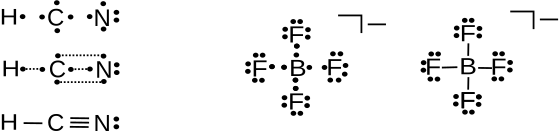
Showtime, let'south do hydrogen cyanide, the poison that might have killed Lewis. The formula is HCN. As usual, this is the correct order of the atoms. The number of valence electrons in the molecule is (i + 4 + v) = 10. When I'g putting the electrons in, I usually beginning by putting each cantlet's valence electrons around it, then I connect the dots into lines. (These steps are shown in the picture).
For a 2nd example, permit's practice the tetrafluoroborate ion, BF4 –. In this example, we have to put B in the middle, because F shouldn't brand more than ane bond. We count electrons: (3 + 7 x iv + 1) = 32. Call up to count +one for the negative charge on the ion. Because B needs to make 4 bonds, we'll give it the extra electron. And so we'll connect the electrons into bonds. In this case, you know that F pulls on electrons much harder than B, then the "shared pairs" will probably be closer to F, even though the pic doesn't show that.
Contributors and Attributions
-
Emily V Eames (City College of San Francisco)

Source: https://chem.libretexts.org/Bookshelves/General_Chemistry/Book%3A_General_Chemistry_Supplement_(Eames)/Lewis_Bonding_Theory/Drawing_Lewis_Structures
Posted by: silvermangerentow1970.blogspot.com
0 Response to "How Do You Draw Lewis Dot Structures"
Post a Comment